

One of the reasons I love physics is because of the great mental models it supplies. I’m always wary of popular science analogies, but I’ve found the idea of phase difference in waves proves instructive in various domains.
To put it simply, consider the wave sin θ: particles that are at 0° and 360° are in phase, which means that their subsequent motion is identical over time. On the other hand, particles that are at 90° and 270° are out of phase: as the one at 90° moves down, the one at 270° moves up.
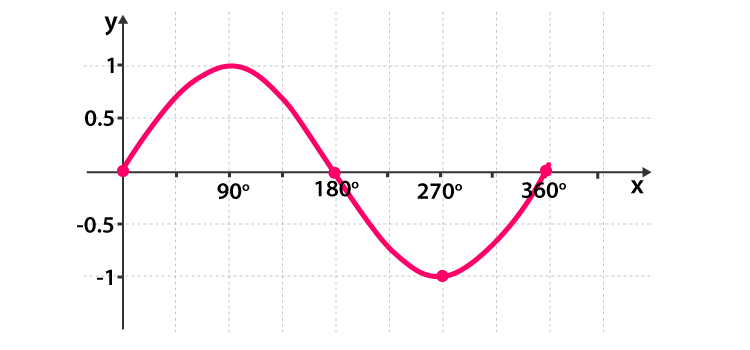
This insight will prove handy as we consider the idea of alignment.
In meeting a few-hundred investors and fund managers over the past 4 years, I have recognised something that separates the best from the rest: alignment. In particular, alignment of interests and alignment of time horizons.
Suppose a fund has a long-term investment philosophy, e.g., an average holding period of 10 years. While raising funds, it is tempting to accept limited partners with shorter time horizons, in a quest to grow assets under management (and thus, fees). But doing so can wreck all sorts of havoc: furious clients begin calling after a quarter of negative returns or underperformance, not recognising the managing partner’s much longer outlook.
The very best fund managers I know turn down — refuse to accept — potential clients, when they sense misalignment. They focus instead on attracting aligned capital.
Say no to misaligned capital. One rupee of aligned capital is worth a hundred rupees of misaligned capital.
— Utpal Sheth (source)
Doing this is difficult in the short run, since it entails willingly forgoing potential fees. But in the long term, it imbues the fund with what my mentor calls temporal leverage: the ability to survive for long in order to thrive.
Consider Nicholas Sleep and Qais Zakaria, who co-ran the Nomad Investment Partnership and returned ~20% CAGR over 20 years.
They also took delight in turning away investors who seemed unsuitable or irritating, regardless of how rich they were. Zakaria chuckles at the memory of a comically awful meeting with a team that managed billions for heirs to the food-packaging company Tetra Pak. These financial advisers demanded access to Nomad’s proprietary stock research as a condition for investing their clients’ money in the fund. Zakaria says the atmosphere grew “frostier and frostier,” with Sleep crossing his arms and legs in a sign of mounting annoyance. After fifteen minutes, Sleep and Zakaria showed their visitors the door.
— William Green, in Richer, Wiser, Happier

Even beyond investment management, misaligned time horizons are a recipe for disaster. Consider these parallels:
Asset-liability mismatch (ALM) in banks and NBFCs. Nearly every banking and NBFC failure (apart from outright fraud) involves ALM: borrowing short term and lending long term. In theory, the lender can roll over their borrowings repeatedly. When the goings are good, this works perfectly well…until the tide turns.
Companies that want to build for the long term are almost always punished by public markets (in the short term). Investing for tomorrow’s profit pools entails forgoing profits today: something not appreciated by most analysts and hedge funds, who prefer higher earnings next quarter. It is crucial to have shareholder-management fit, which is why Sridhar Vembu — one of my favourite thinkers — makes it clear that Zoho has no plans to list anytime soon: they are building for the long haul. It is fitting that Warren Buffett’s Berkshire Hathaway takes great pride in attracting long-term shareholders.
Alignment extends beyond just the temporal sense, to ideas like skin-in-the-game and the principal-agent problem (alignment of interests).
Philosophically, the idea of alignment seems essential to understanding epistemology. The nature of a theory must align with the nature of the world it seeks to explain. Static theories in a dynamic world — and dynamic theories in a static world — are epistemologically unsound. In his profound book Zero To One, Peter Thiel writes-
So, a monopoly is good for everyone on the inside, but what about everyone on the outside? Do outsized profits come at the expense of the rest of society?
Actually, yes: profits come out of customers’ wallets, and monopolies deserve their bad reputation—but only in a world where nothing changes.
In a static world, a monopolist is just a rent collector. If you corner the market for something, you can jack up the price; others will have no choice but to buy from you. Think of the famous board game: deeds are shuffled around from player to player, but the board never changes. There’s no way to win by inventing a better kind of real estate development. The relative values of the properties are fixed for all time, so all you can do is try to buy them up.
But the world we live in is dynamic: it’s possible to invent new and better things. Creative monopolists give customers more choices by adding entirely new categories of abundance to the world. Creative monopolies aren’t just good for the rest of society; they’re powerful engines for making it better. [emphasis mine]
I have a pet theory that I call — and only a nerd would call — the differential compatibility theory of relationships. Whether with a spouse, friend or business partner, successful relationships are characterised by alignment: in values, goals and means.
Other Recent Writings
I wrote these notes from reading Peter Thiel’s Zero To One. In fact, one of my own answers to Thiel’s famous contrarian question has to do with my perspective on the book — most people think Zero To One is a business/investing book, but the truth is that it is a deeply profound tome on building the future.
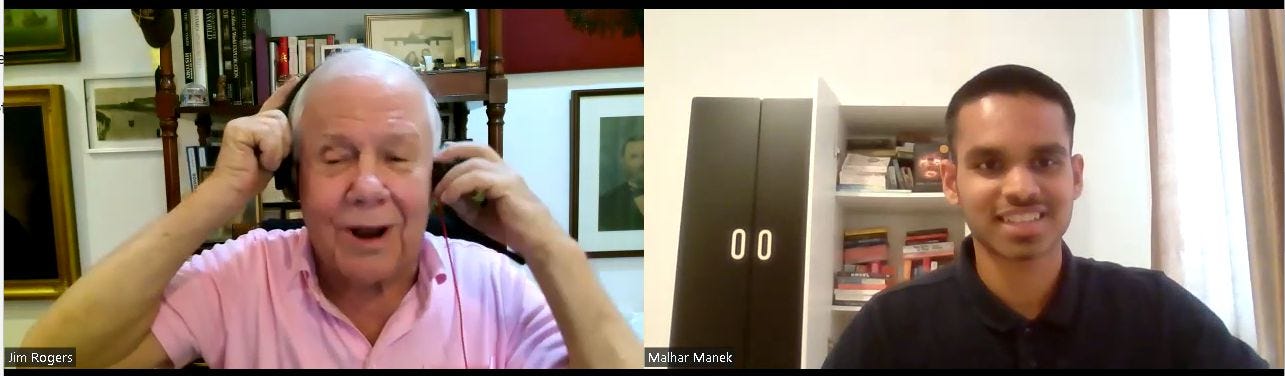
I also had the incredible opportunity of speaking with a legendary investor and one of my favourite authors — Jim Rogers. I wrote about it here.
Feedback and reading recommendations are invited at malhar.manek@gmail.com