

The Fourier Transform takes in time-series data and outputs frequency data. The Fouryear Transform — i.e., college — takes in intellectually curious minds and makes them deep thinkers.
That’s what a mentor told me over the phone on 15 December 2024: the day I got accepted at the University of Chicago.
These past 2 years at UChicago have changed me in the best way possible. Halfway into college, I am sufficiently removed from the application process to have gained perspective on it. At the same time, I also remember exactly how I felt while applying to college: stressed, anxious, overthinking every word on my Common App, grinding out practice SATs. The time feels right for me to carry forward the age-old tradition and dole out (unsolicited) applications advice.
I have two goals with this piece. The first is to provide general advice for someone applying to a top US college. The second is that UChicago is a Dirac-delta kind of college — fine for most people, but the perfect place for a particular type of person — so if you are this kind of person, I hope to convince you to come to UChicago.
This is the essay I wish existed when I was applying to college.
Disclaimer: All opinions and advice in this article are mine alone and do not represent The University of Chicago. I am not a professional college admissions counsellor, so please take my advice with a pinch of salt. Please consult your counsellor before making any decisions.
Know Your College
Most universities have a variant of the ‘why this college’ essay. For example, Cornell asks -
At the College of Arts and Sciences, curiosity will be your guide. Discuss how your passion for learning is shaping your academic journey, and what areas of study or majors excite you and why. Your response should convey how your interests align with the College, and how you would take advantage of the opportunities and curriculum in Arts and Sciences.
And here’s what UPenn’s website says -
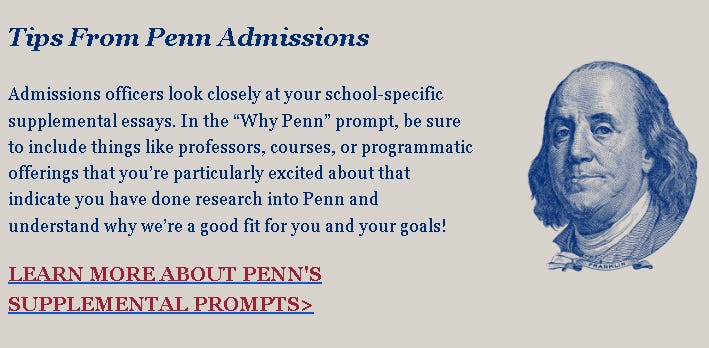
Here’s my recommendation for nailing this essay.
Start early, and every time you read or hear something — anything — about a university, write it down or drop a link in a dedicated notes file. For example, around 10 months before I submitted my applications, I made a Google Doc with a long list of possible colleges I might apply to. Then, every time I came across something to do with that college — an interesting course, professor etc. — I added the link into my Google Doc. It could be from a book, movie, web surfing, a campus tour video, or anything else. Just throw it in there!
Over 10 months, I built up a strong repository of information to draw on for my ‘why this college’ essays. Most people begin researching for their essay only a few weeks before it is due, and as a result they end up writing about the same programs and classes as everyone else — their essays, then, are hardly differentiated from thousands of others.
When I started writing my regular decision essays, my Google Doc already had information about:
Dartmouth’s Take a Faculty Member to Breakfast or Lunch program and Professor Asher Auel, who once taught a course on Gödel, Escher, Bach (my favourite book)
Brown’s creative course offerings
Georgetown’s Ignatius Seminars
Professor Steven Strogatz at Cornell, whose book Infinite Powers made me fall in love with calculus in the 11th grade
UPenn’s interdisciplinary programs, like Management & Technology
And to write the essays, just turn these facts into a narrative. A note I jotted down while reading a UChicago alum’s autobiography1 later became the opening paragraphs of my ‘Why UChicago’ essay:
What does Tao have to do with Van Gogh’s paintings or Stravinsky’s music, I wonder. It’s 1934, and Herbert Simon and his classmates at the University of Chicago are exploring just that. They’re reading papers and debating at their regular Saturday evening meets. Not for a class, not for an exam. Not for scoring marks, but for the sheer love of learning. That’s exactly what I cherish: pursuing knowledge driven by an insatiable curiosity.
With every passing page of Simon’s autobiography, UChicago’s intellectual, interdisciplinary culture becomes more evident to me. This is the very place I’ve dreamed of studying at. Learning ideas in disparate fields – and exploring their connections – gives me an ineffable joy. A community full of curious peers to cross-pollinate ideas with, and a Core Curriculum that not only allows but encourages and enables this, is precisely what I crave.
But I have to dig deeper. Are these facets of UChicago’s culture still relevant today, 90 years after Herbert Simon graduated? Is UChicago still the place for intellectual debate and discussion?
To find the answers, I chat with some current and former students…
Everyone writes about UChicago’s scavenger hunt and $1 milkshakes. But an information sheet that you’ve put together over time for yourself will help you write about niche things, like -
UChicago references in books like Jhumpa Lahiri’s The Namesake in literary fiction; or Bill Browder’s non-fiction thriller about Russian oligarchs, Red Notice
The description of UChicago’s philosophy department in Zen and the Art of Motorcycle Maintenance — one of the seminal philosophical novels of the 20th century
The famous Chicago School of Economics and the legendary Chicago School of Analysis
The Bloch lecture in the chemistry department, and talks by various Nobel Laureates
The Ryerson Astronomical Society, a club on campus that hosts weekly observation nights
The possibilities are endless!2
Competitions
The Common App portal has an option to fill in up to 5 academic awards and honors. To make the most of this, it helps to participate in competitions like AMC 12 for math; F=ma and Sir Isaac Newton exam for physics; essay competitions like John Locke, Marshall Society and Dorian Fisher for economics; and the Wharton High School Investment Competition for finance.
Winning at any of these, then mentioning the prize in the Common App honors, can be a solid boost to your application. Each competition has a different format and style, so check out previous years questions and winning essays to crack it!
Recommendation Letters
Everything you write — from the Common App activities list to your essays — is, by definition, self-aggrandizing. Letters of recommendation help the admissions officer get an independent, third-party opinion from someone who knows you in an academic or extra-curricular setting, so a strong LoR can be a game-changer.
Most colleges ask for 2 teacher recommendations and 1 counselor recommendation, along with an optional LoR from an external mentor. Ideally, demonstrate both left-brain and right-brain sides by taking one LoR from a humanities teacher and one from a STEM teacher.
Usually, your high school will ask you to fill out a brag sheet. Share as many anecdotes as you can, and ask your teachers to write specific instances rather than vague adjectives. See this wonderful LoR advice. Also try to ask your teacher to share context in their LoR — a comment like “X is the best student I’ve had in my 20 years as a teacher” will propel your application to the next level.
Academics and Class Rank
Strong academics are, in most cases, the table stakes for a top college.3 Focus on getting a transcript full of top grades (A* in A-Levels or 7 in IBDP or 5 in APs).
Beyond strong grades in and of themselves, colleges often look at your position within the context of your high school. The magic number here seems to be 10%. For any highly-ranked college, do a Google search and you’ll find that more than 90% of incoming freshmen are those who stood in the top 10% (top decile) of their high school graduating class. One example from Northwestern’s class of 2027:

Or this table from UChicago’s common data set:

Having said that, many high schools do not report class rank. Still, it can be useful to mention being valedictorian or subject topper in your Common App honors.
SAT
Once you are at 1550 or above, that is good enough for any top college and your SAT score won’t be your bottleneck — focus on other parts of your application. I took the SAT twice and got 1510 (790 math and 720 EBRW) and 1560 (790 math and 770 EBRW).
Here are my tips for the evidence-based reading and writing part of the SAT: think about every single word in an answer option, and focus on eliminating the wrong choices. Even one word is enough to reject an answer choice. Do the official practice tests on Bluebook in exam conditions, and make your own notes on how to refine and improve. Make sure you deeply understand every single question you got wrong, and why, so that you don’t repeat these mistakes.
Ideally, try to nail it on your first attempt, and preferably don’t give the SAT more than twice (colleges are able to see how many times you gave the SAT).
Don’t be in a hurry — I think somewhere around the end of junior year (11th grade) is a good time to give the SAT.
Common App Essay
Show a clear before and after. Show a clear change in your mindset/worldview arising from some event, realisation or experience. If you can think and write deeply and philosophically, your essay will probably be a winner. Watch this video to see what I mean. You can find some wonderful past essays online — take the time to read them!
For essays, I remember finding College Essay Guy extremely helpful — especially check out his ideas on uncommon connections and essence objects.
Common App Activities
In your Common App activities section, the key is to write with active verbs, demonstrate tangible impact, and include numbers and statistics. How many views did your video/blog/tweet get? How many subscribers did your newsletter garner? How many people did you impact at an NGO? Don’t leave your application reader guessing — provide specific details and tangibles.
Demonstrate Thoughtfulness
Try to reflect and introspect on not just what you have done (research, internships etc.) but why. What did you learn from your experiences? How did they help you in other places? Why are you doing [XYZ]?
For instance, I took an online math course and described it in additional information: “My math in school mostly relates to numerical answers, so I am taking this course to learn proof-based mathematics.”
Bonus Tip
Email professors — but only if you have value to add!
Subject to doing thorough research and being convinced that you can add value, it may be a good idea to email professors at the colleges you are planning to apply to. Read their research papers and projects and add something of value to them — inputs, questions etc.
I read a paper by a professor from NYU and sent him an email. His reply –
Dear Malhar, what you are doing is very impressive! I haven’t done any further work on fractals since that paper you cite a long time ago. I wish you all the best in your inquiries. Have you thought about applying to NYU for college?
I got a similar reply from a Dartmouth professor too. One can always include such excerpts of replies from professors in the Common App additional information section for that college.
The Place Where Fun Goes To Die?!4
The best way to find out if UChicago is the right place for you is to start writing the essays5 — if you’re the right fit, you’ll have a blast writing the ‘quirky’ essay. When I was applying, I scoured the internet for examples of successful UChicago quirky essays — I made a compilation of my favourite ones, here.
My own quirky essay was about cryptography and information theory, and I wrote it as a dialogue between R2-D2 and C-3PO. You can write either in a detached, impersonal way about the subject you’ve chosen (cryptography in my case), or find a way to relate the topic to your own personal experiences too — both methods work, though it’s good to try and do the second.
UChicago is all about intellectual stimulation and curiosity, learning for its own sake, debate and discussion, and a love for learning across disciplines. Make sure you show that you understand this, in your ‘Why UChicago’ essay. Here is a wonderful podcast by a former UChicago admissions officer — I myself listened to it 2 or 3 times.
You can get creative too — I once heard on a webinar that someone wrote their ‘Why UChicago’ essay as a letter to Hogwarts, explaining why they chose to attend UChicago over Hogwarts!
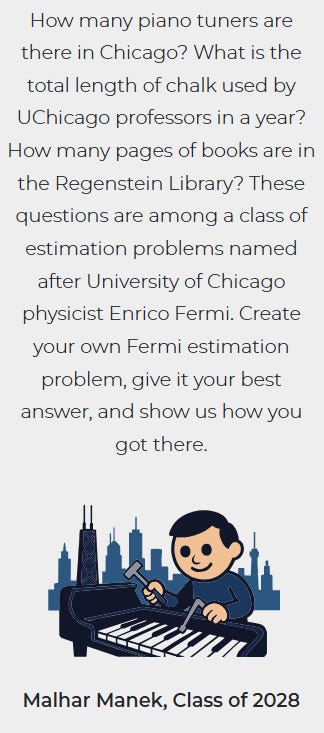
By the way, the prompts for the quirky essay aren’t written by admissions officers — they’re crowdsourced from current and former students, through a form that’s sent out every year. I have a little bit of experience with it myself — I once suggested a prompt through the form that ended up getting selected! Here it is:
Here’s an excellent college advice post by PrepScholar — one that I must’ve read a dozen times while I was applying.
If you’ve gotten into college, congratulations! Welcome to the Fouryear Transform! I’d recommend discovering Cal Newport’s study strategies6 and watching this Ted Talk.
I have been the fortunate recipient of great advice and mentorship throughout my college application process and beyond, so it is my duty to pass it on. If you’re applying to UChicago, I’m happy to read an essay draft and share my thoughts — just shoot me an email at malhar.manek@gmail.com
Best wishes — you’ve got this!
Models of My Life by Herbert Simon
I went into college thinking I would double major in physics and economics — and chose UChicago, among other reasons, because it has excellent physics and economics departments.
Then I took some excellent math classes in freshman year (Honors Calculus IBL) and switched over to the math major — and turns out UChicago has a brilliant math department too.
Most recently, I have become fascinated by quantum computing — and guess what? Chicago is the quantum hub!
There are exceptions, of course, for example recruited athletes.
When my parents heard that UChicago is called “the place where fun goes to die”, they half-joked that I would absolutely love it! And many of my U of C friends say the same happened to them!
A word on formatting: the UChicago essays are uploaded, not typed into a box, so you might be wondering if there’s a particular style of formatting required. I’m not aware of any such requirement (at least when I applied, in 2023), but I myself used Times New Roman 12.
I have found Cal Newport’s advice on deep work and studying strategies extremely useful. Check out his blog posts on advice for rising freshmen, how to become a deep thinker at college, the straight-A method, and becoming a Zen valedictorian.